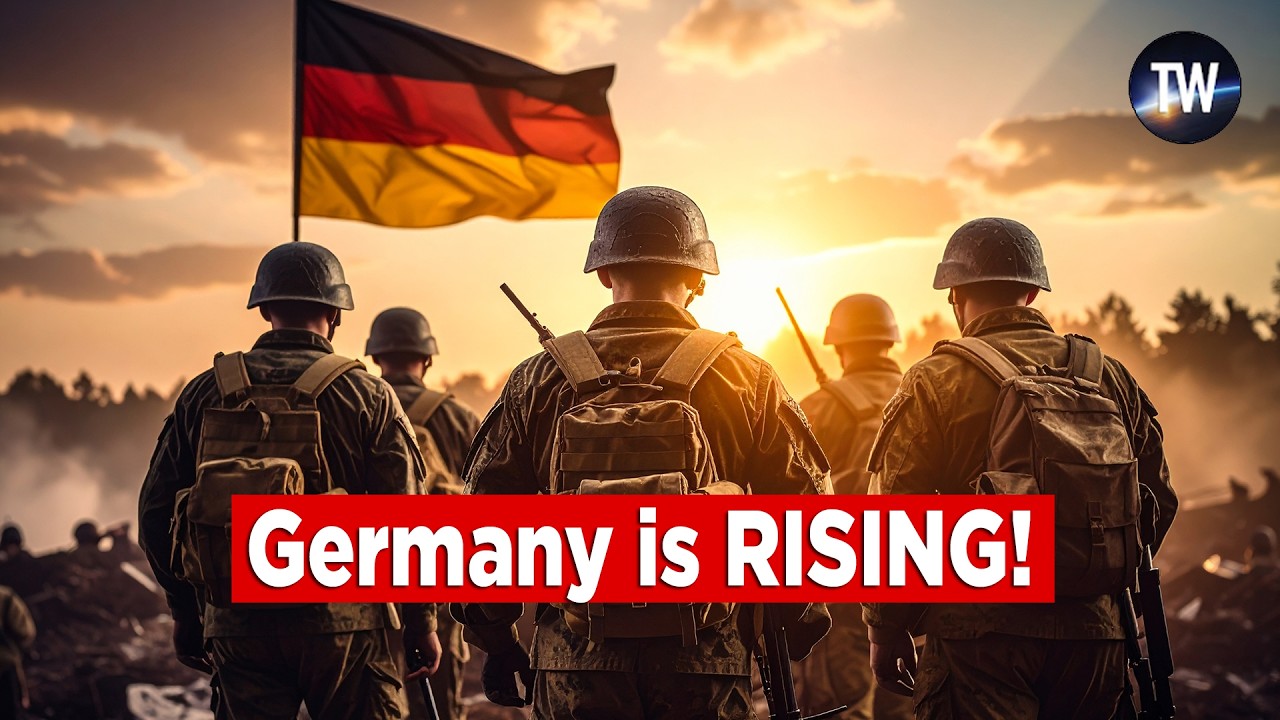
[The text below represents an edited transcript of this Tomorrow’s World program.]
The Beast of Revelation Is Rising
The Bible is once again proving its skeptics wrong.
Who foresaw the dramatic shift in German thinking that began suddenly less than four years ago—a shift that continues to intensify?
The answer is those who understand Bible prophecy—prophecies highlighted here at Tomorrow’s World for many years. We did not come up with this due to greater intellect, or by looking into a crystal ball, following Nostradamus, or consulting a spook in the night. It is all there in the scriptures.
Tomorrow’s World has for decades shown from the biblical books of Revelation, Daniel, Isaiah, and elsewhere that Germany will once again become a dominant military force in Europe—and that events will cause ten nations or kingdoms in Europe to give their power over to a German-led military and economic colossus that Scripture calls the Beast. Naysayers have ridiculed the idea of another European revival of the Roman Empire, but that is what is beginning to happen even as you view this program. It’s never a good idea to bet against God and His word!
Europe and Germany Prepare for War
Dear friends, our world is right now taking a turn that will lead to disaster for mankind. It will not look like disaster, but that is exactly what the Bible foretells for the near future.
What many fail to see is a military and economic colossus rising up—right now—before our very eyes.
Europe is a sleeping giant for which few have devoted much thought, but on February 21, 2022, Russian President Vladimir Putin sent troops into Ukraine as “peacekeepers”—and three days later launched a full-scale invasion. That was a wake-up call for European leaders, and former German Chancellor Olaf Scholz immediately called for an epochal shift in people’s thinking—from pacifism to war-readiness. Germans suddenly recognized the need to build a strong military force to counter a threat from the East. Mr. Scholz called for spending €100 billion (U.S. $108 billion) to rebuild his nation’s armed forces and to boost annual military spending to more than 2 percent of GDP. Part of the €100 billion included the purchase of F-35 stealth aircraft capable of carrying nuclear weapons. Other European countries also received that wake-up call from Mr. Putin and are ramping up their military spending.
The election of United States President Donald Trump was a second wake-up call for Europeans to look to themselves for their defense. Mr. Trump’s election was worrisome to European leaders, but at the Munich Security Conference, U.S. Vice President J.D. Vance shocked European leaders with his February 14 lecture.
This Foreign Policy headline from February 18 highlighted the shock NATO member states had regarding the speech.
European leaders are reeling from a weekend of high-level diplomacy that has laid bare just how dramatically the second Trump administration is overhauling transatlantic relations.
The article that followed explained:
Even before the reelection of U.S. President Donald Trump, European leaders were anxiously deliberating what the possible return of the U.S. leader would mean for the future of the NATO alliance and the Russia-Ukraine war. But a series of speeches, phone calls, and decisions surrounding the recent Munich Security Conference have only confirmed their worst fears (“The Speech That Stunned Europe,” ForeignPolicy.com).
The U.S. was not the only country with a new leader. Germans went to the polls on February 23 and Europeans speculated what the outcome would be—not so much who would win, but what the new leader would mean for Europe.
Nuclear Deterrence Revives German Military
The European Council on Foreign Relations (ECFR) reported:
Friedrich Merz is on the precipice of becoming Germany’s next chancellor. If successful, his conservatism and quest for new allies to secure Europe’s nuclear deterrent could create a “two-speed Europe” (“Double speed: What Merz and a German right-turn would mean for Europe,” ecfr.eu, February 20, 2025).
Note that—a nuclear deterrent. An older generation would be horrified to think that the country that led to the loss of tens of millions of lives in two world wars last century would possess nuclear weapons. But that is exactly what is contemplated.
And what is meant by a “two-speed Europe?” Although the European Union is currently composed of 27 nations, not all nations share the Euro currency.
And in that sense, there is already a two-speed Europe—an inner core and a broader union. The Bible speaks of ten nations that give their power over to a charismatic leader. We may expect that there will be a broad-based economic union with a smaller inner core military union that the Bible tells us is fragile and will only last for a short time.
Germany’s “Seismic Shift” Prioritizes Defense
Consider this explanation from German-Foreign-Policy.com explaining what is needed from the new German government.
In Berlin, government advisors and foreign policy experts are calling for a massive increase in the military budget, drastic cuts in social spending and the vigorous indoctrination (“change of mentality”) of the population. Rapid militarisation is, they argue, the task of the next German government. These demands are spelled out in the current issue of Internationale Politik (IP), a journal published by the influential German Council on Foreign Relations (DGAP). Its cover story is entitled: “What the world expects from Germany after the election.” One contributor writes, for example, that the next government must prepare society “for Germany to become the leading European power, diplomatically and militarily” (“All or Nothing,” German-Foreign-Policy.com, March 4, 2025).
Only a precious few in the world understand where this is leading.
There is a military and economic colossus on the rise in the heart of Europe that will impact your world and that of your loved ones, and it’s happening far more quickly than you might imagine.
German Chancellor Sheds Dependence on U.S.
I also mentioned the rift in Trans-Atlantic relations that has come about since the election of President Donald Trump. This is more than a mere spat between allies. Its significance has far-reaching consequences, as pointed out in this BBC.com report.
Germany’s chancellor-in-waiting didn’t wait for the final results of his country’s election on Sunday to herald a new era in Europe. Declaring the US indifferent to this continent’s fate, Friedrich Merz questioned the future of Nato and demanded Europe “boost its own defences. Quickly” (“New German leader signals seismic shift in transatlantic relations,” BBC.com, February 24, 2025).
Although a previously strong advocate of the Trans-Atlantic alliance, Merz recognized the seriousness of the rift in relations and that there is no turning back.
“My absolute priority will be to strengthen Europe as quickly as possible so that, step by step, we can really achieve independence from the USA,” he added. Merz hinted that the endeavour was so urgent that he was not sure on whether the transatlantic alliance leaders gathering for a summit in June “would still be talking about Nato in its current form or whether we will have to establish an independent European defence capability much more quickly” (“New German leader signals seismic shift in transatlantic relations,” BBC.com, February 24, 2025).
All of this was prior to the blowup in the White House between Volodymyr Zelenskyy and the U.S. President and Vice President on February 28. European Union foreign policy chief Kaja Kallas told Politico:
“Today, it became clear that the free world needs a new leader. It’s up to us, Europeans, to take this challenge” (“‘Free world needs a new leader’: Europe defends Zelenskyy after Trump attack,” politico.com, February 28, 2025).
Politico later reported:
“Shortly after his victory, Merz began proclaiming a radically different creed, one fit for an alarming new reality in which U.S. President Donald Trump’s America could no longer be relied on to protect Europe — and could even act to harm it.” (“Will the threat of Trump end Germany’s austerity zeal?,” March 18, 2025).
Note that last statement.
America could no longer be relied on to protect Europe — and could even act to harm it.
Merz is taking rearming to a degree that makes his predecessor’s €100 billion look puny in comparison. The BBC reported that shortly after Merz was elected:
German lawmakers have voted to allow a huge increase in defence and infrastructure spending—a seismic shift for the country that could reshape European defence. A two-thirds majority of Bundestag parliamentarians, required for the change, approved the vote on Tuesday. The law will exempt spending on defence and security from Germany’s strict debt rules, and create a €500bn ($547bn; £420bn) infrastructure fund. This vote is a historic move for traditionally debt-shy Germany, and could be hugely significant for Europe, as Russia’s full-scale invasion of Ukraine grinds on, and after US President Donald Trump signalled an uncertain commitment to Nato and Europe’s defence. (“Germany votes for historic boost to defence spending,” BBC.com, March 18, 2025).
U.S. Tariffs Widen the Gap with Europe
If Europeans were shocked into reality by the Trump administration regarding the defense of the continent, they were no less stunned and offended by the level and scope of tariffs announced on April 2. America’s “Liberation Day” would impose a universal 10 percent tariff three days later on all imported goods and even higher tariffs would kick in on April 9 for dozens of countries.
America is seen by an increasing number of Europeans as a threat, as an enemy, and this should be a wake-up call on this side of the Atlantic. But it’s not Europeans only who view America as a threat.
A serious rift has been created between the United States and Canada, and Canada’s new Prime Minister Mark Carney is turning to Europe for greater ties economically, as are a number of other countries.
“Countries are ready to work with reliable trade partners in Europe”… European Commission President Ursula von der Leyen told POLITICO.
“In a more and more unpredictable global environment, countries are lining up to work with us,” the Commission president said without naming Trump or the U.S. In recent weeks she has spoken to leaders from Iceland, New Zealand, Malaysia, the Philippines, Canada, India and the United Arab Emirates who were looking for “strong, reliable partners” (“Von der Leyen: World is ‘lining up’ to work with Europe amid Trump’s trade war,” Politico, April 22, 2025).
And let us not forget China and all of Central and South America. While the United States boasts of 340 million consumers, the combined nations of the European Union have 450 million consumers.
German-Led Europe Emerges
Germany and Europe are poised to become both an economic and military superpower on the world scene.
Revelation points to ten nations or leaders giving their power over to a charismatic leader it calls the Beast. And Daniel describes these nations as being a fragile mixture of iron and ceramic clay—not naturally binding together.
The North Atlantic Treaty Organization was formed April 4, 1949 following World War II. NATO’s first Secretary General, Lord Ismay, explained the aim behind the new military alliance as it was then.
Keep the Russians out, the Americans in, and the Germans down (A history of NATO: ‘Keep the Russians out, the Americans in, and the Germans down’ - New Cold War: Know Better, Nov 7, 2016).
What we now see is Russia knocking at Europe’s eastern door, Germany rising, and the United States walking away.
It is not uncommon for allies to have disputes and differences, but this is a historic geopolitical shift that should be chilling to students of European history and Bible prophecy. The rise of an economic and military juggernaut involving a combination of central European nations is something we have warned about for decades.
Germany Will Do “Whatever It Takes”
What we now see happening is the rise of a German-led Europe beginning to build a powerful world-class military force with nuclear weapons totally independent from the U.S.—their former protector.
As reported by Politico, in an article titled, “Will the threat of Trump end Germany’s austerity zeal?”:
“In view of the threats to our freedom and peace on our continent,” the mantra “whatever it takes” must now apply to Europe’s defense, Merz told reporters earlier this month as he announced a historic borrowing plan that could unleash €1 trillion in new spending for defense and infrastructure over the next decade.… “The meeting in the White House between Zelenskyy and Donald Trump really showed the whole drama in which we are living today in terms of security policy, and that is why we had to act quickly,” Merz said on public television on Sunday [March 16]. “We now have to take a more independent path from America,” he added. “Europe’s time has come” (March 18, 2025).
Yes, Europe. Not Germany alone.
Reuters reported this response from the EU Commission President following the White House blowup between the US administration and Ukrainian President Zelensky.
The European Commission proposed on Tuesday to borrow up to 150 billion euros ($157.76 billion) to lend to EU governments under a rearmament plan driven by Russia's war in Ukraine and fears that Europe can no longer be sure of U.S. protection…. Von der Leyen put forward the 150 billion euro fund for priorities such as air defence, missiles and drones as part of a package of proposals that she said could mobilise up to 800 billion euros for European defence (“EU proposes borrowing 150 billion euros in big rearmament push,” Reuters.com, March 4, 2025).
The transformation of Germany and Europe is historic, and is taking place at breakneck speed.
This BBC headline appeared on March 31: “Germany decides to leave history in the past and prepare for war.” The article went on to say:
Germany’s military, the Bundeswehr, recently got the all-clear for a massive increase in investment after parliament voted to exempt defence spending from strict rules on debt. The country’s top general has told the BBC the cash boost is urgently needed because he believes Russian aggression won’t stop at Ukraine. “We are threatened by Russia. We are threatened by Putin. We have to do whatever is needed to deter that,” General Carsten Breuer says. He warns that Nato should be braced for a possible attack in as little as four years…. “And the sooner we are prepared the better” (bbc.com, March 31, 2025).
European nations are circling the wagons as they realize they must stand on their own in the face of a threat from the East, and abandonment from the West.
This Is Germany’s Destiny in Bible Prophecy
The military awakening of Europe, and especially in Germany, is no small matter. Twice in the last century a militarized Germany plunged the world into wars that took the lives of tens of millions. We know that it is not in their heart to bring about a round three, but the descendants of ancient Assyria will once again wield the sword against the Israelite nations. As it tells us in Isaiah 10, the modern-day descendants of ancient Assyria, is indeed God’s rod of punishment.
Woe to Assyria, the rod of My anger and the staff in whose hand is My indignation. I will send him against an ungodly nation, and against the people of My wrath I will give him charge, to seize the spoil, to take the prey, and to tread them down like the mire of the streets. Yet he does not mean so, nor does his heart think so; but it is in his heart to destroy, and cut off not a few nations (Isaiah 10:5–7).
Germany’s biblical identity is explained in detail in our resource Germany in Prophecy. This great nation is destined to once again shake the world, but it will not do it alone. Ten nations will lend their military support to a charismatic leader, who will bring the whole world once again to war.
A Crisis Will Clinch Germany’s World Domination
As we have already seen, Germany is gearing up for war in as little as three to four years. But as the Bible shows, a crisis, a charismatic leader, a miracle-working religious figure, and ten nations or leaders will combine to use this military might in a manner that no one currently intends.
The United States and Europe are pulling apart, and with the Russian threat to their east, Europeans recognize their need to unite as one for their own defense. Furthermore, Germany realizes its need to take the lead. The book of Revelation describes what we will see in the near future. Though we cannot know the exact timing in advance—as shown in the previous segment of this Tomorrow’s World program—the time it will take Europe to prepare to withstand an attack by a nuclear superpower to its east is short—perhaps four years or less.
But Bible prophecy explains that this Beast power will do far more than defend Europe against a Russian attack. As happened twice in the last century, this German-led force of “kings” (nations or groups of nations) will bring the whole world to war once again. We read in Revelation 17.
The ten horns which you saw are ten kings who have received no kingdom as yet, but they receive authority for one hour as kings with the beast. These are of one mind, and they will give their power and authority to the beast (Revelation 17:12–13).
The Second Coming Will End the German Reign
And when does this happen? At the return of Jesus Christ, as clearly indicated by the next verse.
These will make war with the Lamb, and the Lamb will overcome them, for He is Lord of lords and King of kings; and those who are with Him are called, chosen, and faithful (Revelation 12:14).
Yes, it is at the time of Christ’s return. My father once told me that the Europeans could never get together—conventional wisdom based on his knowledge of the differences between the European peoples. Yet, this condition is exactly what the Bible describes.
These same ten nations found in Revelation are depicted in the biblical book of Daniel as the feet and toes of a giant image that King Nebuchadnezzar saw in a dream, recorded in chapter 2. We know the ten toes of that image are the same as the ten kings of Revelation, because of the context and how they are destroyed by the returning Messiah.
Whereas you saw the feet and toes, partly of potter’s clay and partly of iron, the kingdom shall be divided; yet the strength of the iron shall be in it, just as you saw the iron mixed with ceramic clay. And as the [ten] toes of the feet were partly of iron and partly of clay, so the kingdom shall be partly strong and partly fragile. As you saw iron mixed with ceramic clay, they will mingle with the seed of men; but they will not adhere to one another, just as iron does not mix with clay (Daniel 2:41–43).
The next verse tells us when this fragile alliance takes place—when Jesus Christ returns to set up a different kingdom.
And in the days of these kings the God of heaven will set up a kingdom which shall never be destroyed; and the kingdom shall not be left to other people; it shall break in pieces and consume all these kingdoms, and it shall stand forever (v. 44).
The Bible tells us far more than I have time to explain in this short program, and that is why we are offering you our free resource, Germany in Prophecy. However, I want to leave you with a very encouraging passage in the 19th chapter of Isaiah regarding the future of the great nation of Germany.
In that day Israel will be one of three with Egypt and Assyria—a blessing in the midst of the land, whom the Lord of hosts shall bless, saying, “Blessed is Egypt My people, and Assyria the work of My hands, and Israel My inheritance” (Isaiah 19:24–25).
Events are unfolding so rapidly that between the time this program is recorded, edited, and sent to stations for review before airing, who knows how our world may change? Be sure to keep reading Tomorrow’s World magazine and watching this Tomorrow’s World program to ensure that you are not caught off guard by fast-moving events that are shaping our world.
And be sure to come back again next time when Rod McNair, Wallace Smith, and I will be right here ready to share with you the teachings of Jesus Christ, the good news of His coming Kingdom, and the end-time prophecies of the Bible. See you right here next time.